

You know the feeling.
A good employee starts to seem a little more distant. Replies a little shorter. Participates a little less.
You think: busy. Personal stuff. A rough patch.
And then they resign.
And now it's obvious. The signals were there. They were just never said out loud.
It's not your fault. Wellbeing rarely drops suddenly. It happens slowly, in frustrations that are never said out loud, in energy that quietly withdraws. Not dramatically. Not visibly.
It requires that you ask. Regularly. Anonymously. And that you do something with the answers.
That's what this guide is about.
What is employee wellbeing?
Wellbeing isn't the same as people being happy.
It's whether your employees are doing well enough to perform, contribute and stay.
Denmark's National Research Centre for the Working Environment (NFA) defines it like this: employees thrive best when there's a balance between the demands placed on them, their competencies and the resources available to them: leadership, collaboration and influence over their own work.
In short: wellbeing isn't a feeling. It's a result.
A result of whether the workplace provides what it takes for a person to perform and feel good at the same time.
And that result can be measured.
What affects employee wellbeing?
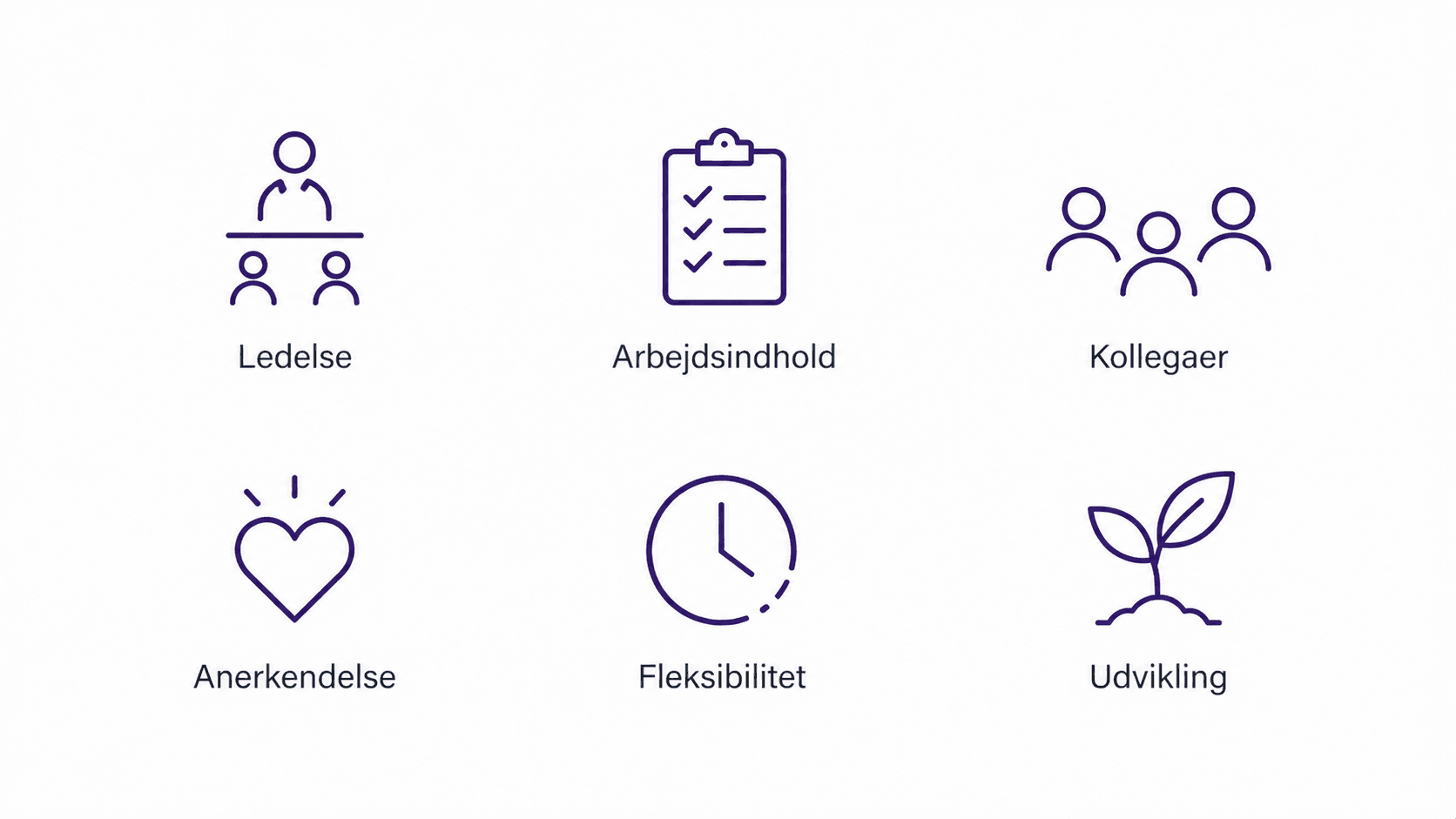
Wellbeing isn't one thing. It's the sum of several factors. And most of them are invisible from the outside.
Leadership is the single biggest factor. According to Gallup, the immediate manager accounts for at least 70% of the variance in employee engagement across teams. Not pay. Not the office. The manager.
People don't leave companies. They leave managers.
Work content is about whether the work feels meaningful and appropriately challenging. Too little challenge creates stagnation. Too much creates stress. Both are wellbeing problems.
Colleagues. Relationships at work have a direct impact on daily energy. NFA's research shows that increased peer support is the factor with the greatest potential gain for the psychological work environment.
Recognition isn't about money. It's about effort being seen and valued. An employee who never hears that they're doing well starts to doubt whether it matters.
Flexibility. Whether everyday life can fit together with life outside work. It's not a question of the home office. It's a question of trust.
Development. Whether there's something to look forward to, professionally and personally. Employees who can't see a direction for themselves start looking for another one.
None of these can you see from the outside.
They require that you ask.
What does poor wellbeing cost?
It's easier to ignore wellbeing than it is to measure it.
It's also more expensive.
Productivity drops quietly
Gallup's latest State of the Global Workplace report shows that only 21% of the world's employees are actively engaged. 62% are not. They show up, but give no more than necessary. 17% are actively disengaged and actively work against the workplace.
It costs the global economy an estimated $438 billion in lost productivity every year.
For Denmark the picture is the same. NFA calculates that a better psychological work environment could yield a potential gain of DKK 5.5 billion a year, equivalent to roughly DKK 2,300 per full-time employee.
These aren't HR figures. They're leadership figures.
Employees who consider leaving rarely do so from one day to the next
It's a decision that matures over months.
During that period there's a window. A window to ask, listen and act.
And a window to avoid the bill that follows.
According to Gallup, it typically costs 50–200% of an employee's annual salary to replace them: recruitment, onboarding, lost knowledge and lost productivity during the vacancy. For specialists the figure can exceed 200%.
A resignation isn't an expense. It's a bill for something that already went wrong.
→ See the full calculation: What does a resignation actually cost?
How wellbeing pays off
Researchers from the Oxford Wellbeing Research Centre analysed data from 1.8 million employees across 230 organisations in 49 industries. The conclusion was clear: companies with high wellbeing deliver better productivity, higher customer loyalty and lower employee turnover. And companies at the top of wellbeing measurements outperformed the S&P 500 by 20% over two years.
Wellbeing isn't a perk.
It's a business decision.
What is quiet quitting, and why is it hard to spot?
There's probably an employee in your company who never complains.
Shows up on time. Does exactly what's expected. Never quits.
But never creates anything new either. Doesn't lift the team. Never gives more than the minimum.
Gallup calls it quiet quitting. And it's not laziness. It's disconnection.
62% of the world's employees fall into that category. Physically present. Mentally absent.
The dangerous part is that they're invisible. They don't cause problems. They don't speak up. They look fine. On paper.
And they never disappear suddenly. They disappear slowly.
You notice it when the good employee stops bringing ideas. When their engagement in meetings quietly drops. When they reply more briefly to messages.
You read it as busyness.
It's a signal.
→ Read more: When is it too late to ask?
What's the difference between wellbeing, satisfaction and engagement?
The three terms are often used interchangeably. That's a mistake, because they each require different action.
Satisfactionis the absence of dissatisfaction. A satisfied employee is okay with their pay, colleagues and working conditions. They don't complain. They don't quit. But they don't necessarily create anything either.
Engagementis the active choice to invest yourself in the work. To bring energy and initiative. To pick up tasks that aren't strictly your own.
Wellbeing is the foundation beneath both. Without wellbeing, neither satisfaction nor engagement is possible over time.
A satisfied employee stays.
An engaged employee creates.
An employee with high wellbeing can be both.
Many companies measure satisfaction and conclude they have engagement under control. It's not the same thing. And it's not the same as wellbeing.
→ Read more: Engagement isn't the same as satisfaction
How to measure wellbeing
There are three primary methods. They don't replace each other. They complement.
The workplace assessment: the statutory baseline
According to the Danish Working Environment Authority, all companies with employees are legally required to carry out a workplace assessment (APV) at least every three years, or when there are significant changes to the work. The assessment must cover both the physical and psychological work environment.
The workplace assessment is a good baseline. But it's a snapshot.
A lot can happen in three years.
The big employee survey: the deep analysis
A comprehensive, structured employee survey (typically once a year) gives a thorough picture of wellbeing, engagement and the work environment across the organisation.
It's good at identifying patterns and systematic problems.
It's bad at catching what's happening now.
Because wellbeing doesn't wait for your annual survey.
→ Read more: Why the big employee survey doesn't work
Pulse surveys and eNPS: the ongoing signal
A pulse survey is a short, frequent measurement: typically one to three questions, sent out monthly or quarterly. It captures the mood now, not as it was a year ago.
The simplest pulse tool is eNPS: “How likely are you to recommend your workplace to a friend or colleague?”
The answer is anonymous, on a scale from 0 to 10. It takes 30 seconds. And it tells you more about what your employees really think than most performance reviews ever would reveal.
Because anonymity doesn't change what people think.
It changes what they're willing to say.
→ Read more: What is eNPS?
Anonymity is a prerequisite, not a feature
Imagine you receive a survey from your manager about the work environment.
You know your answers can be traced back to you. You know who's reading them. You know there's a team meeting in two weeks.
What do you say?
The same as everyone else. True enough to feel honest. Nice enough not to cause problems.
Research shows that anonymous surveys produce up to 58% more honest answers, especially on the topics that actually matter: leadership, culture, the direction of the organisation.
Exactly the topics that rarely come up in a one-on-one performance review.
But anonymity is only half the solution.
The other half is action. Employees stop answering honestly if they never see anything happen. They start answering when they experience that feedback leads to change.
“We heard you on this. And here's what we've done.”
That sentence is worth more than any guarantee.
→ Read more: Anonymity in employee surveys
How often should you measure?
The answer depends on what you want to know.
Every three years: The workplace assessment. Statutory, and a good baseline. Too infrequent to follow the development.
Once a year:The big employee survey. Good for depth and patterns. Too infrequent to catch what's happening now.
Monthly: A pulse survey with eNPS. Captures the mood continuously. Gives time for analysis and action before the next round.
Gallup recommends ongoing measurement. Engagement can move significantly week by week. Not just year by year.
The annual survey shows the direction.
The pulse check shows whether you're moving there.
The two complement each other. Neither is enough on its own.
What is a good eNPS score?
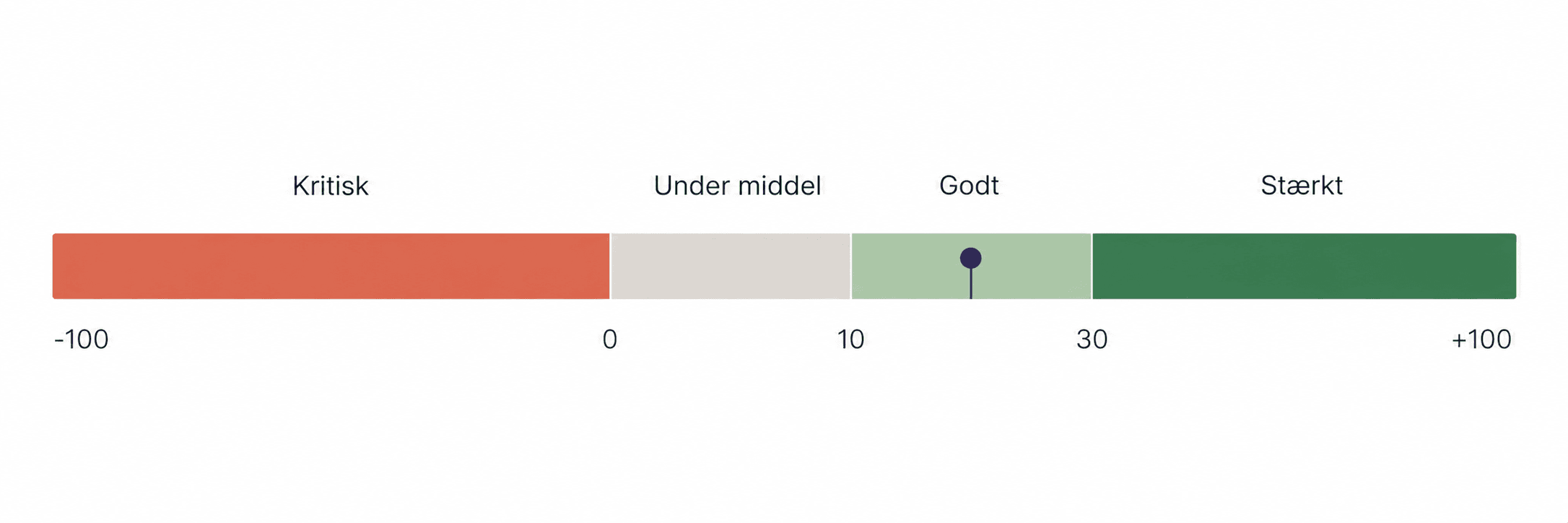
The eNPS score ranges from −100 to +100. It's calculated by subtracting the percentage of detractors (score 0–6) from the percentage of promoters (score 9–10).
Here's what the scores mean in practice:
| Score | Assessment |
|---|---|
| Below 0 | Critical. Investigate the causes immediately. |
| 0–10 | Below average. Improvements are needed. |
| 10–30 | Good. The norm for well-functioning companies. |
| 30–50 | Strong. A clear surplus of promoters. |
| Above 50 | Exceptional. Rare, but achievable. |
Nordic companies generally score 10–20 points higher than the global average, driven by strong labour-market conditions and cultural norms around work-life balance.
But a score is never static.
The direction matters more than the level.
A company at +40 that's declining is a bigger problem than one at +10 that's rising.
The only thing that matters is whether you're moving in the right direction.
What do you do with the results?
Data isn't valuable in itself.
It's what you do with it.
When you get your eNPS score, the question isn't: “Are we good enough?” It's: “What's happening, and what do we do about it?”
Three things you do:
Look at the direction, not just the level. Has the score risen or fallen since last time? What happened in that period?
Look at the open responses. The numbers say what. The open comments say why. You need both.
Communicate what you're doing.Tell your employees what you heard, and what you're doing about it. That's what keeps the response rate high next time. And the time after.
A wellbeing measurement without action isn't just useless.
It sends a signal: we ask, but we don't listen.
That signal is harder to repair than a bad result.
Wellbeing doesn't require an HR apparatus
You don't need an HR manager. You don't need a big wellbeing programme. You don't need consultants.
You need one good question. Asked regularly and anonymously.
That's what Emplio is built for.
You send one question. You see the answers. You act on what stands out.
No IT setup. No long implementation. Ready in under 5 minutes.
The cheapest resignation is the one that never happens.
Start measuring before the bill begins.
Create free accountRead more
- What is eNPS? The explanation, the calculation and what you do with the score.
- Engagement isn't the same as satisfaction. Know the difference.
- When is it too late to ask? The early signs no one sees.
- What does a resignation actually cost? The full bill.
- Anonymity in employee surveys. The prerequisite for honest answers.
- Free employee survey. Get started without commitment.