
Most leaders only discover the problems when people resign.
That's too late.
By then the decision has been underway for a long time. You just didn't see it.
eNPS gives you a signal before it happens.
Not a gut feeling.
Not “I think the mood is good”.
A concrete data point you can track over time.
The question
It all starts with one question:
“On a scale from 0 to 10, how likely are you to recommend your workplace to a friend or colleague?”
That's it.
No long surveys.
No 60 questions.
No HR project.
You ask.
They answer anonymously.
You get a number.
And most importantly: you can track the development.
What the answers really mean
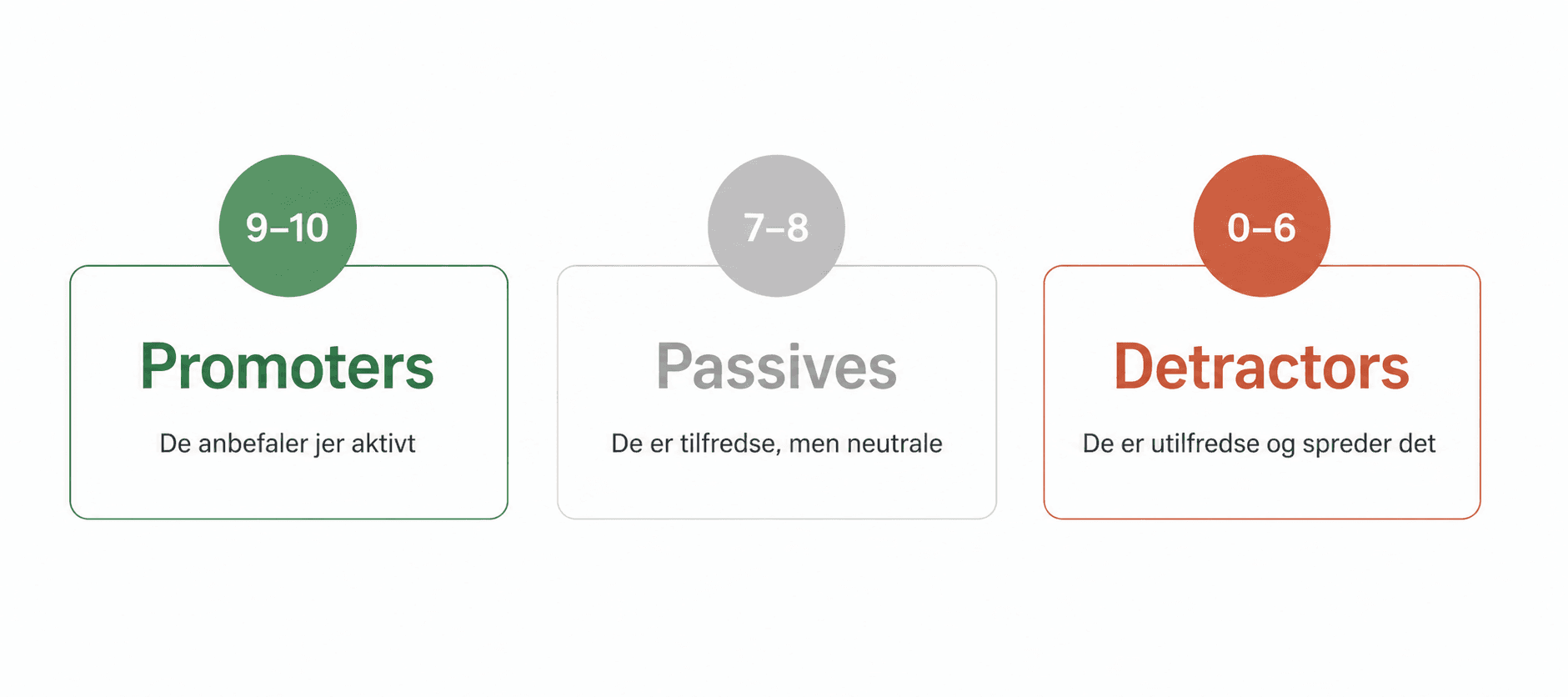
The answers fall into three groups.
Promoters (9–10)
The ones who actually like working with you.
They're engaged.
They recommend you.
They help lift the culture.
Passives (7–8)
They're satisfied. But no more than that.
They stay.
But they don't fight for you.
And they leave if something better comes along.
Detractors (0–6)
This is where the risk lies.
They're dissatisfied.
And it spreads faster than you'd think.
How to calculate eNPS
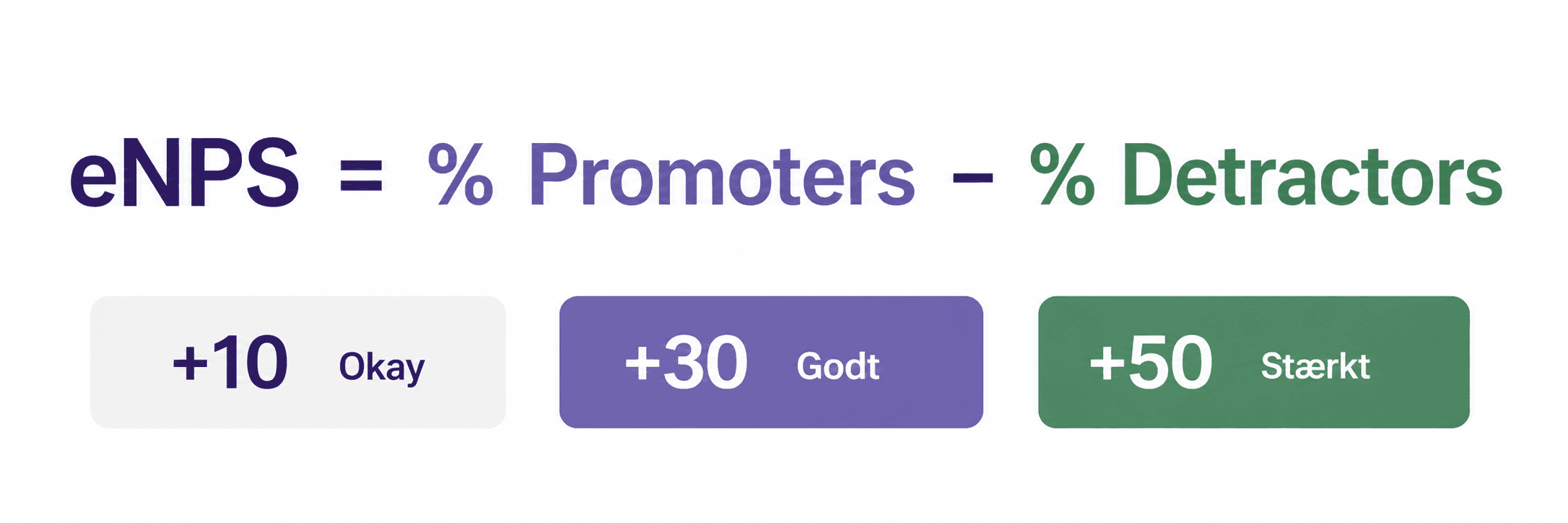
eNPS = % Promoters − % Detractors
That gives a score between −100 and +100.
- Above 0 → more satisfied than dissatisfied
- Above 30 → good
- Above 50 → strong
But honestly:
It's not the number itself that's interesting.
What most people get wrong
eNPS isn't a target.
It's a signal.
A company at +40 might be heading down.
A company at +10 might be heading up.
The only thing that matters is the direction.
- Going from +10 → +30 → you're doing something right
- Dropping from +35 → +15 → there's a problem
Even if +15 looks “fine” on paper.
Why it works
Because it's simple.
You get honest answers because it's anonymous.
You get answers because it's only one question.
And you can act on it because it's concrete.
It doesn't require an HR department.
It doesn't require a consultant.
It doesn't require a big setup.
It just requires that you actually do something about it.
eNPS tells you how things stand. But it doesn't change anything on its own. Your actions do.
Ready to see what your employees really think?
Create free account